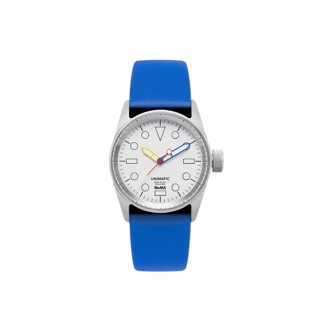
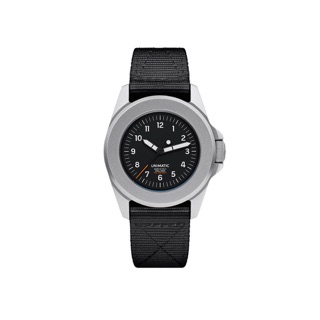
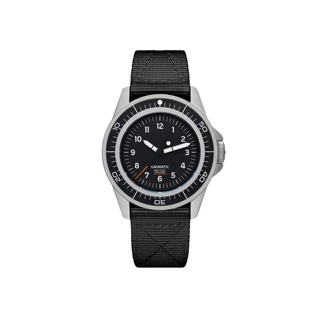
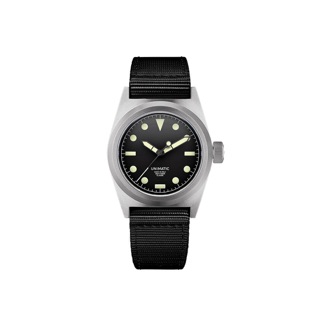
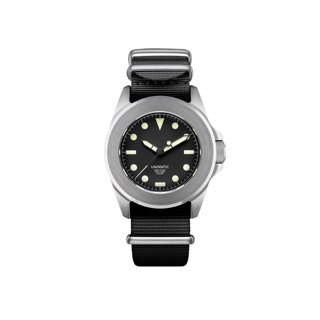
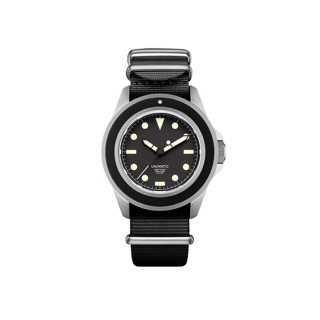
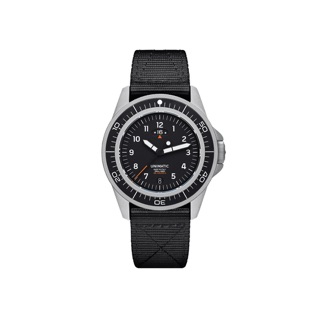
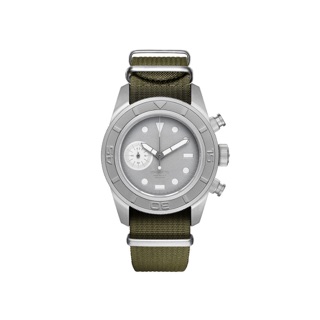
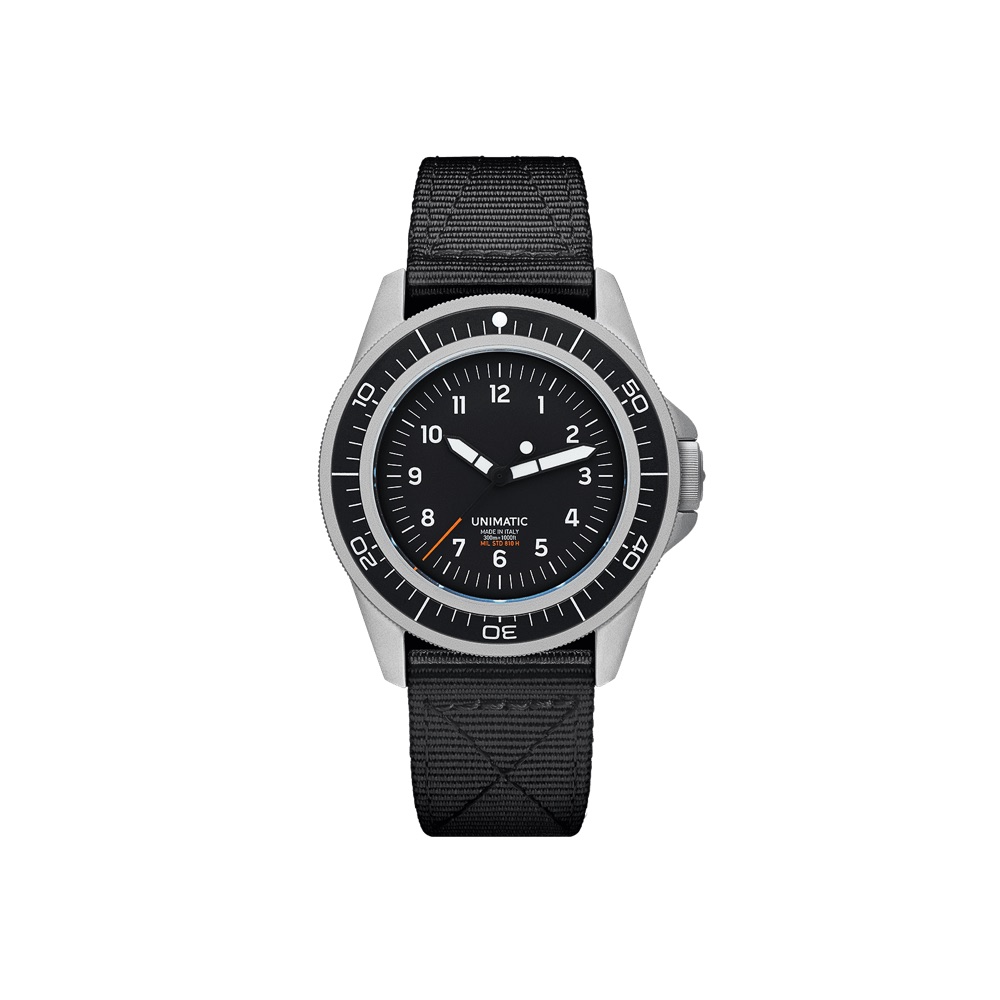
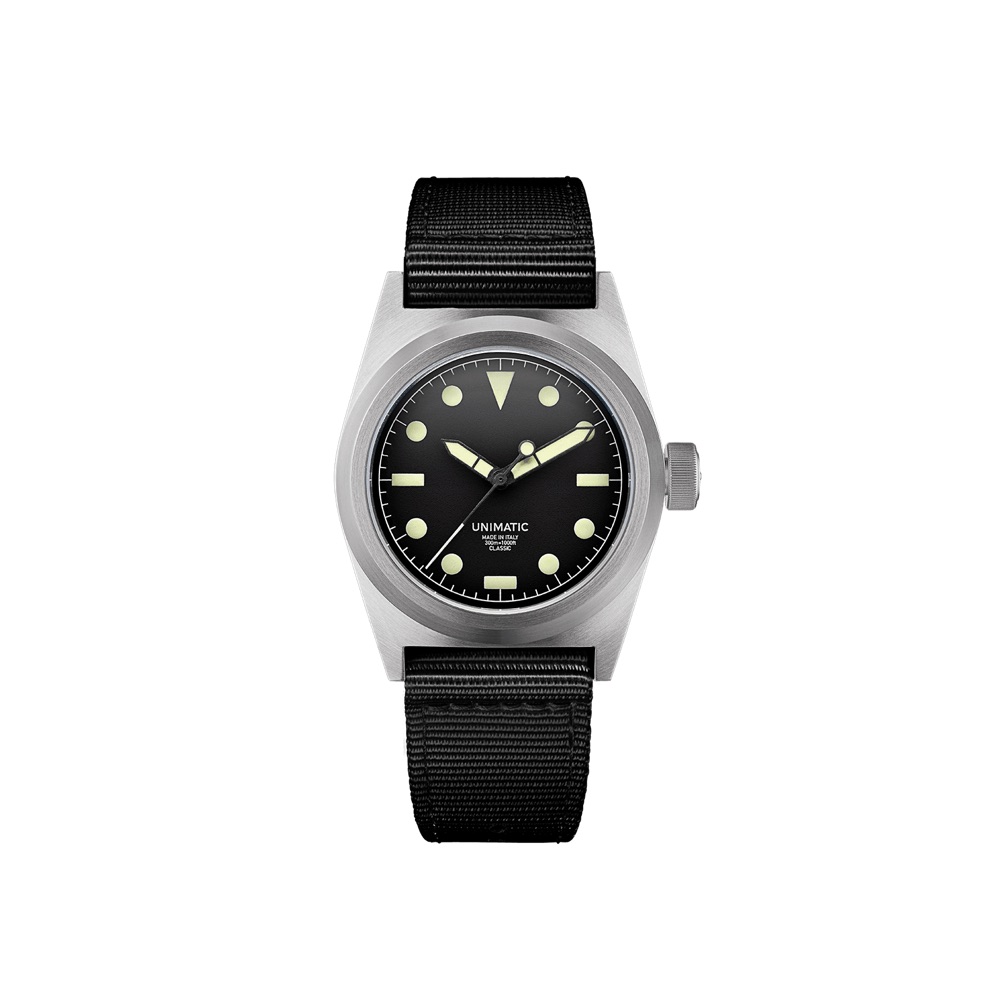
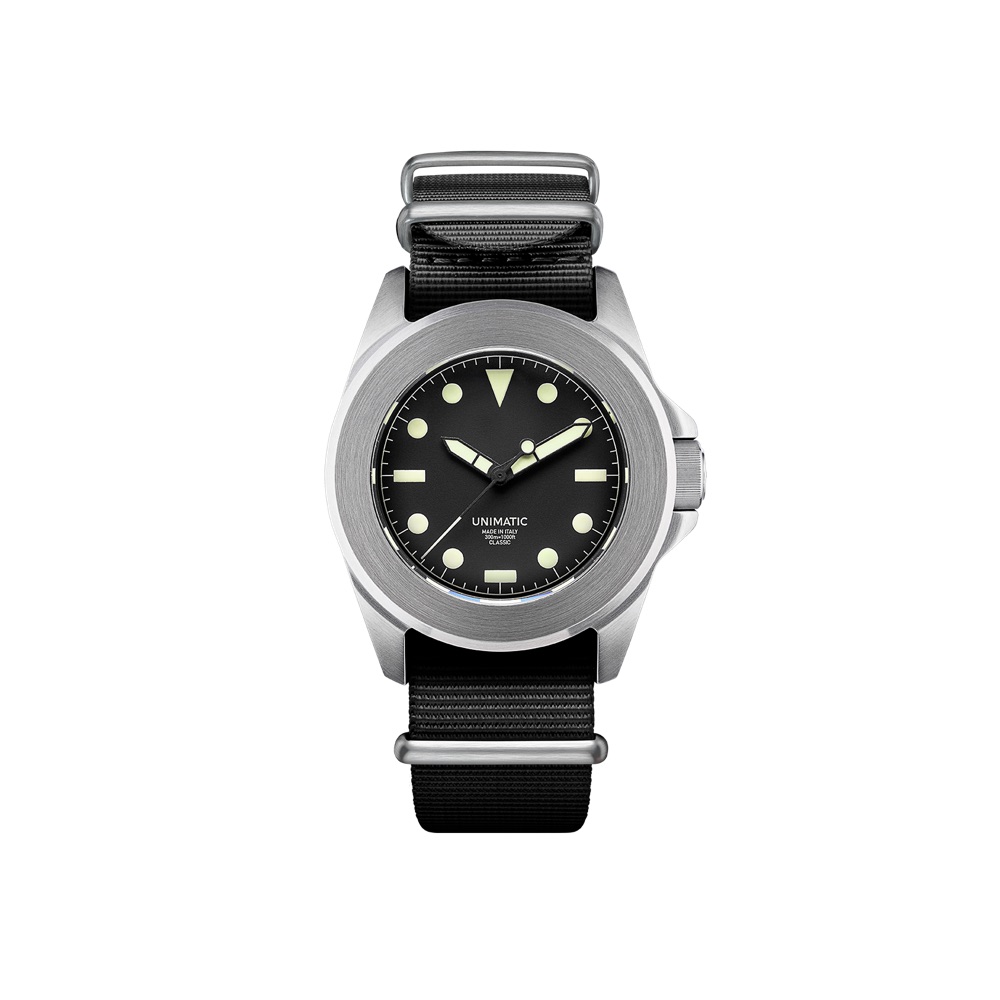
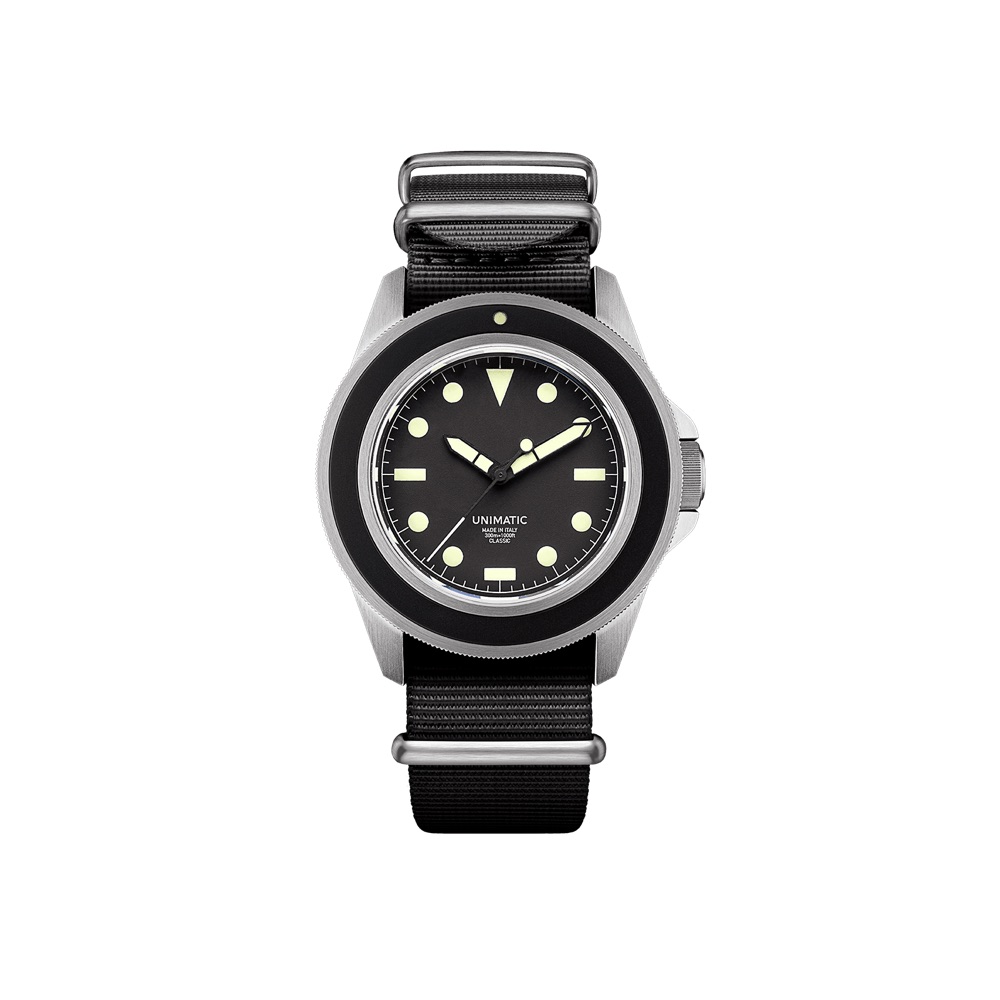
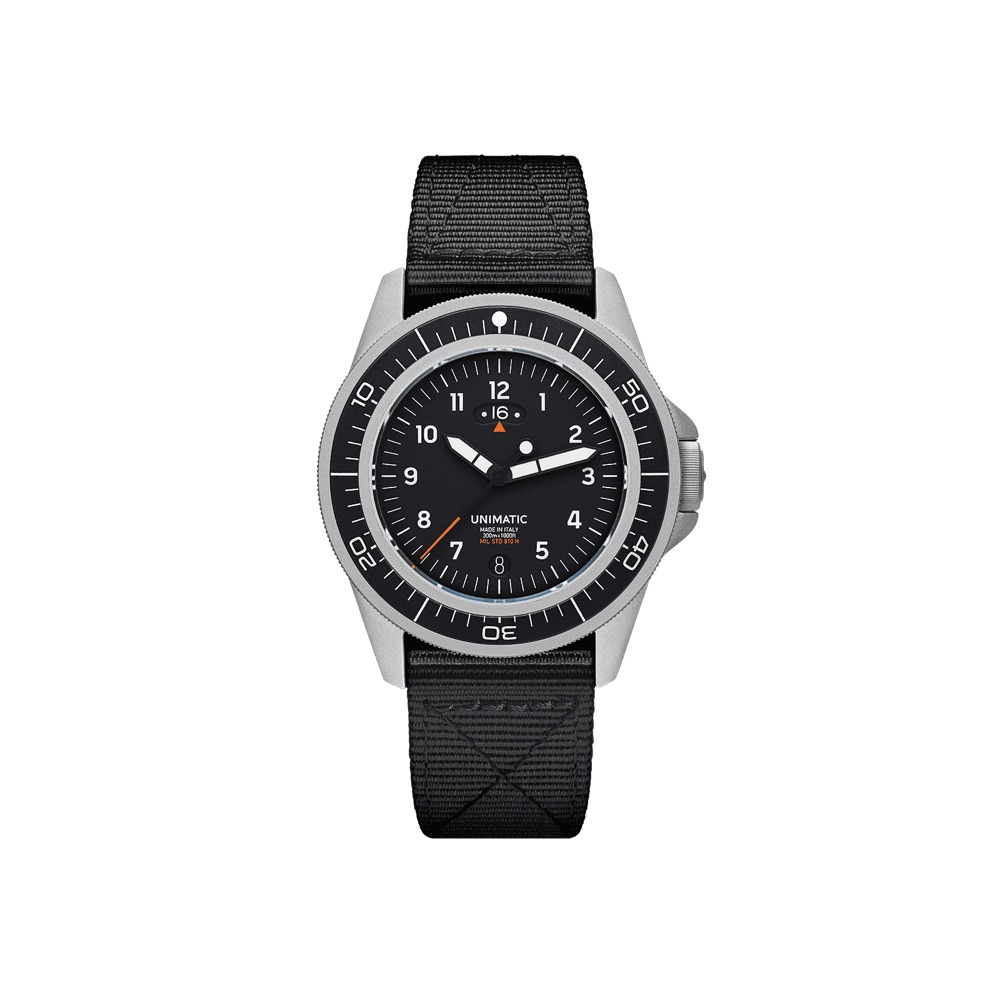
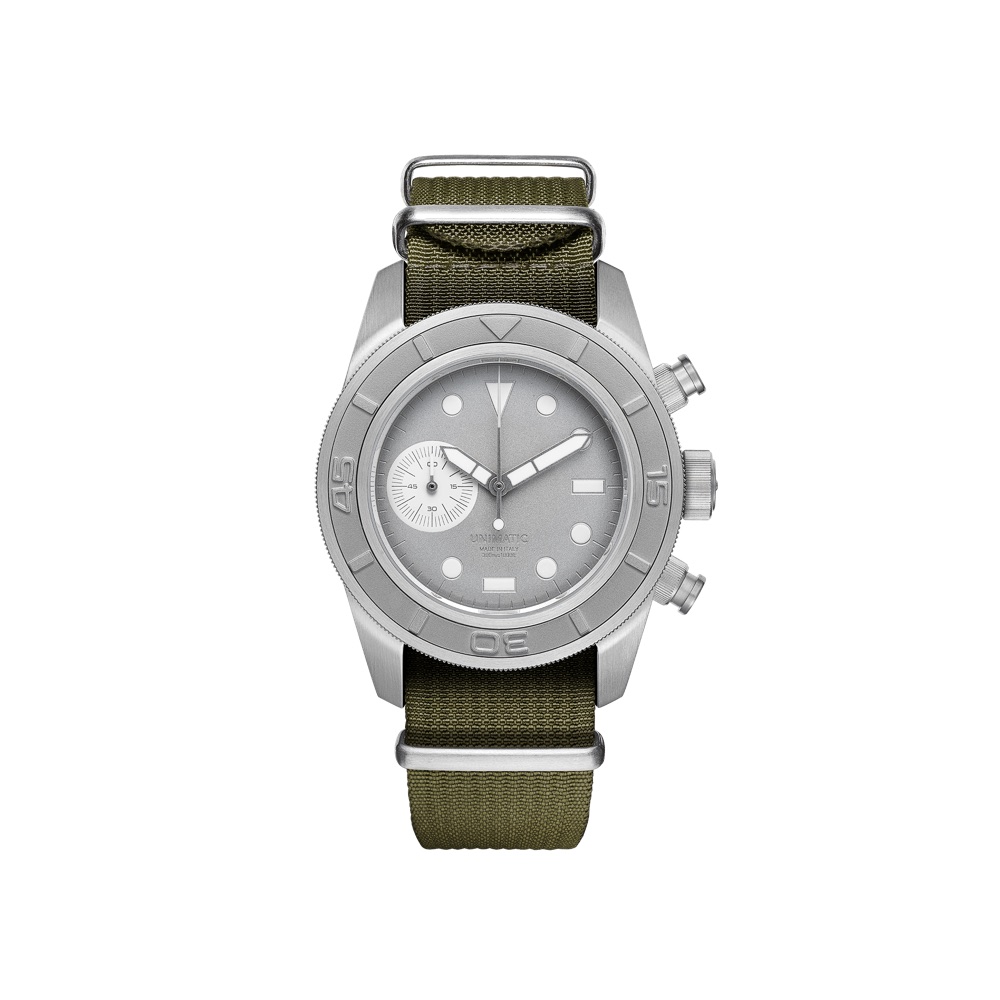
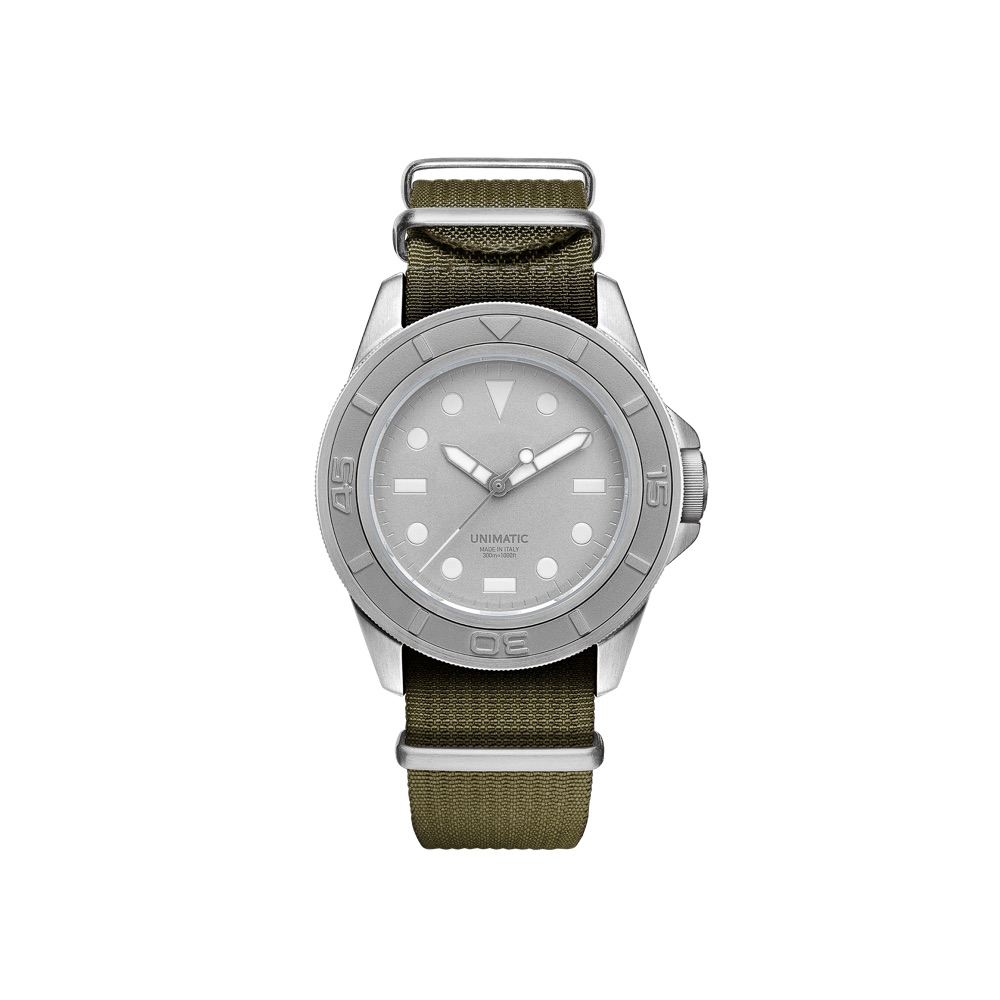
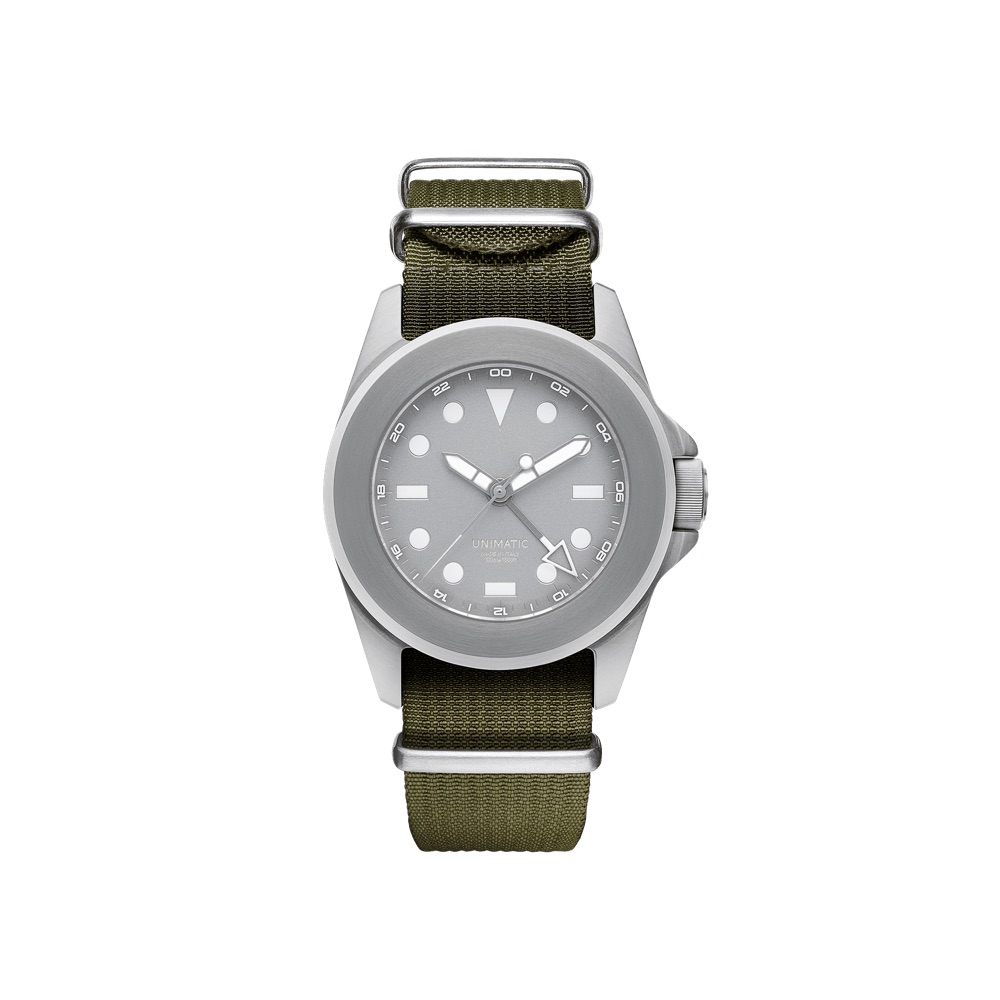
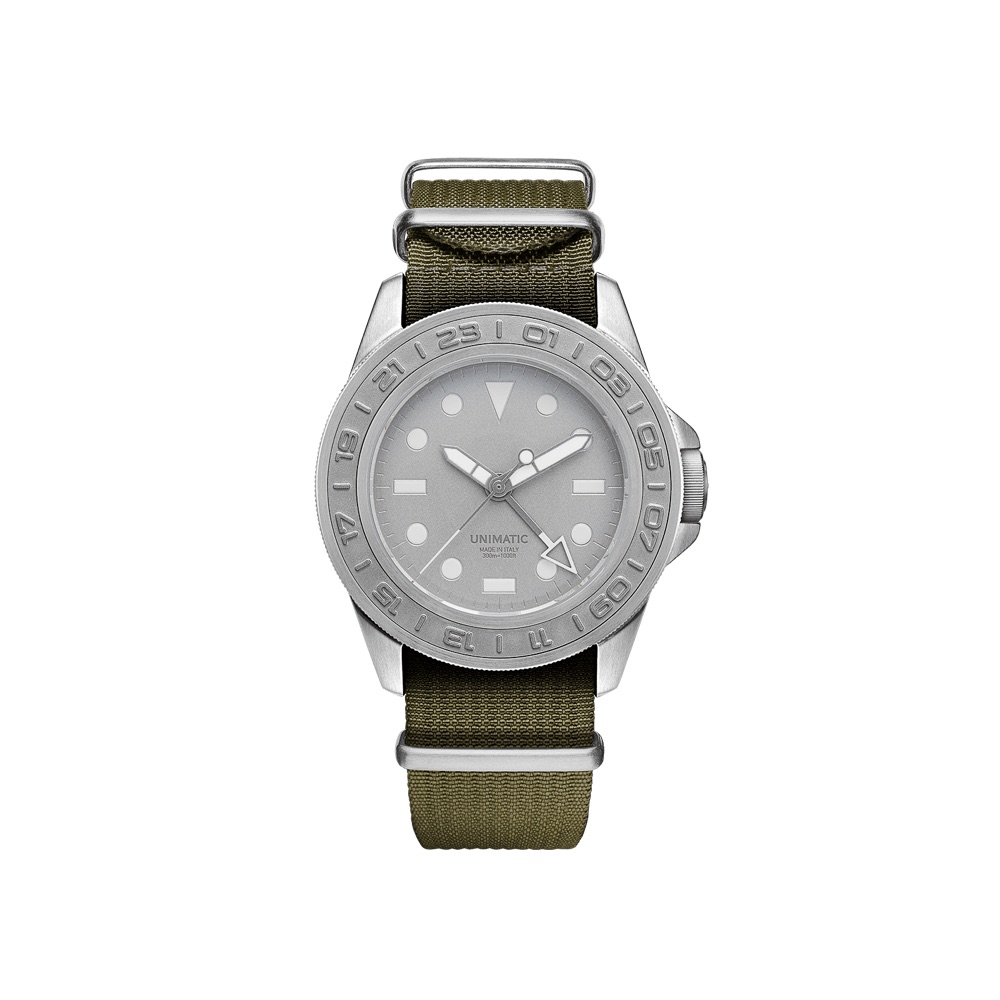
Unimatic sells 10 priced models across Classic, Toolwatch and Limited Edition, $515 for a quartz field watch to $1,050 for an automatic GMT, every one rated to 300 m. The brand publishes no lug-to-lug and no thickness, so every figure in those two columns is a reviewer's measurement rather than Unimatic's.
Checked 19 September 2026 · list prices on the maker's site that day unless marked street
Unimatic is a Milan brand, founded in 2015 by two industrial designers around what its about page calls design by removal, and since 2021 it has assembled and tested its watches in-house near Milan. It sells direct from its site and a Milan flagship, plus the retail partners on its store locator, with a 24-month worldwide warranty stated on every product page. The site lists in euros but runs a US storefront with its own dollar prices: the dollar figures on this page are the ones shown with the country set to United States on 19 September 2026, set by the brand rather than converted at the day's rate, with the euro price in parentheses on each model's first mention.
Three things the spec sheets settle, and one they do not. Water resistance is 300 m on every model, the quartz field watch included. Every crystal is sapphire with an inner anti-reflective coating, double-domed on the Modello Uno, Due and Tre and flat on the Modello Quattro and the Toolwatch line. Lug width is 22 mm on every Classic and Toolwatch page; the limited-edition pages do not state it. What the brand publishes nowhere is lug-to-lug or thickness, the U5S page's 11.6 mm being the single exception. The figures in those two columns are measurements printed in reviews by Worn & Wound, Fratello and Monochrome, cited per row in the data behind this page, and where a review measured a sibling reference on the same case the confidence is marked low. The consequence is that a buyer sizing a Unimatic against a Lorier or a Traska is comparing a tape measure against a published sheet; the entries use the figures without repeating this.
The numbering is simple once stated. Classic and Toolwatch models are numbered in yearly batches, so a UC1 bought this year carries a number within this year's run, not a position in a fixed edition. Limited Editions, the references with an AEG suffix, are editions of 250, individually numbered. The Modello Cinque U5S, a 36 mm Sellita SW200-1 diver made in runs of 300 and 50 and as a 75-piece MoMA collaboration, shows no price and is mostly sold out, so it appears in the table without an entry below.
Founded2015
BasedMilan, Italy
AssembledAssembly and testing in-house near Milan, Italy (brought in-house 2021, per about page)
Read the table by line, then by movement. Classic (UC prefix) means a Seiko NH35A automatic in brushed 316L steel with Super-LumiNova C3, $655 to $760. Toolwatch (UT prefix) means quartz in sandblasted steel with C1 lume: a Seiko VH31A with a sweeping seconds hand in the UT1 and UT4, and a Swiss Ronda 515.24D GMT in the UT1-GMT, $515 to $760. Limited Edition (AEG suffix) means brushed steel, C1 lume and an olive drab seatbelt NATO with a spare black NATO in the box, $840 to $1,050: an NH35A in the U1-AEG, a Seiko NH34A GMT in the U4-GMT-AEG and a Seiko VK64 meca-quartz chronograph in the U3-AEG. Case sizes by Modello: Uno is 40 mm and 41.5 mm across the bezel, Due is 38 mm, Tre and Quattro are 40 mm. Nothing ships on a bracelet.
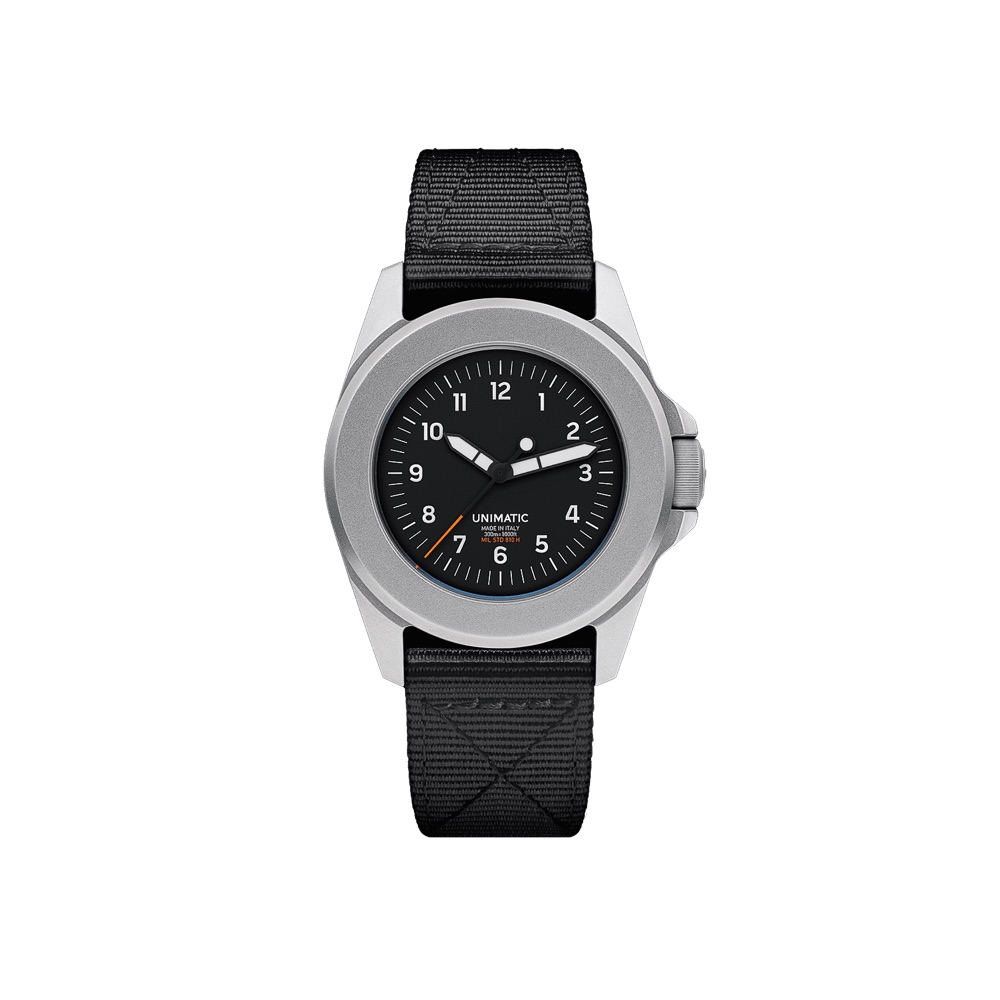
The cheapest Unimatic at $515 (€430), and the way to have the Quattro case for $140 less than the automatic: 40 mm, 49 mm lug-to-lug, 12 mm thick, 22 mm lugs, 300 m, Seiko VH31A quartz with a sweeping seconds hand, 2.8 mm flat sapphire, fixed monoblock bezel, Super-LumiNova C1, sandblasted 316L, on a black nylon two-piece quick-release strap. Numbered in yearly batches. Against the UC4 Classic it is the same case with quartz in place of the NH35A and sandblasted rather than brushed, 1.7 mm thinner. The Vaer C5 at $349 is the solar field watch for $166 less, at 100 m and 1 mm shorter; the Unimatic's $166 is 200 m of rating and the Milan assembly.
Bezel120-click unidirectional countdown, matte black insert
LumeSuper-LumiNova C1
Case material316L stainless steel, sandblasted
Price$620 (US price on the maker's site)
The quartz Uno at $620 (€520), and the sensible way into the diver if the automatic's $140 buys nothing you want: 40 mm (41.5 mm across the bezel), 49 mm lug-to-lug, 13.2 mm thick, 22 mm lugs, 300 m, Seiko VH31A, 2.5 mm flat sapphire, a unidirectional 120-click countdown bezel with a matte black insert, Super-LumiNova C1, sandblasted 316L, black nylon two-piece strap. Numbered in yearly batches. The UC1 Classic is the same case with the NH35A, a double-domed crystal and C3 lume for $140 more; the sheet is otherwise identical. The Vaer D4 solar at $429 is the alternative that never needs a battery, at 200 m and 3 mm shorter.
The Unimatic for a wrist under 7 inches, at $655 (€550): 38 mm, 47.6 mm lug-to-lug, 13.7 mm thick, 22 mm lugs, 300 m, Seiko NH35A, 2.7 mm double-domed sapphire, fixed monoblock bezel, an 8 mm screw-down crown, Super-LumiNova C3, brushed 316L, black nylon two-piece quick-release. Numbered in yearly batches. At 47.6 mm it is the shortest of the automatics by 1.4 mm, and that 1.4 mm is the whole reason to choose it over the UC4 at the same price and movement. The Nodus Sector Deep at $650 is 38 mm and 47 mm on the same NH35 at 500 m, on a bracelet; the Unimatic's $5 buys the Milan assembly.
The automatic field Unimatic at $655 (€550): 40 mm, 49 mm lug-to-lug, 13.7 mm thick, 22 mm lugs, 300 m, Seiko NH35A, 2.8 mm flat sapphire, fixed monoblock bezel, Super-LumiNova C3, brushed 316L, a screw-down caseback engraved with a rosa dei venti, on a black heavy-duty NATO. It is the UT4 with the automatic and a brushed finish for $140 more, 1.7 mm thicker. Nodus's Sector Deep runs the same NH35 at $650 in a 38 mm, 47 mm case rated to 500 m, so the Unimatic's price is the case and the Milan assembly, not the movement. The UC2 is the same watch 2 mm smaller if 49 mm is too long.
Bezel120-click unidirectional, black anodized aluminium insert
LumeSuper-LumiNova C3
Case material316 stainless steel, brushed
Price$760 (US price on the maker's site)
The core Unimatic at $760 (€640), and the one on this site's dive list under $1,000: 40 mm (41.5 mm across the bezel), 49 mm lug-to-lug, 13.6 mm thick, 22 mm lugs, 300 m, Seiko NH35A, 2.5 mm double-domed sapphire, a unidirectional 120-click bezel with a black anodized aluminium insert, Super-LumiNova C3, brushed 316 steel, on a black nylon NATO. Its neighbours there are the Lorier Neptune ($699, 39 mm, 46 mm, 200 m) and the Traska Freediver ($735, 40.5 mm, 48 mm, 200 m), both shorter and both on bracelets. Against the Lorier the Unimatic gives 100 m more rating and 3 mm more length for $61 more. Nothing on the sheet is exclusive to it.
Bezel120-click unidirectional countdown, matte black
LumeSuper-LumiNova C1
Case material316L stainless steel, sandblasted
Price$760 (US price on the maker's site)
The only Swiss movement in the regular lines, and at $760 (€640) the same price as the UC1, so the choice is quartz with a second zone against an automatic without one: 40 mm, 49 mm lug-to-lug, 22 mm lugs, 300 m, a Ronda 515.24D quartz GMT with a roughly 45-month battery life per the brand, 2.5 mm flat sapphire, unidirectional 120-click countdown bezel, Super-LumiNova C1, sandblasted 316L, black nylon two-piece strap. No review fetched gives a thickness for this reference, so the column is blank rather than borrowed. The Vaer G5 at $989 is the automatic true GMT for $229 more; the Islander NH34 callers start at $369.
The chronograph at $840 (€730), an edition of 250, and the longest Unimatic at 51 mm lug-to-lug by 2 mm, which settles it for most wrists under 7 inches before the movement comes into it. 40 mm, 13.7 mm thick, 300 m, Seiko VK64 meca-quartz (battery timekeeping, mechanical chronograph module), 2.5 mm double-domed sapphire, a unidirectional 120-click bezel with a sandblasted aluminium insert, Super-LumiNova C1, brushed 316 steel, olive drab seatbelt NATO with a spare black NATO. Lug width is not stated on the page. Lorier's Gemini at $499 is a hand-wound mechanical chronograph for $341 less; the Unimatic's $840 is the case, the rating and the number on the caseback.
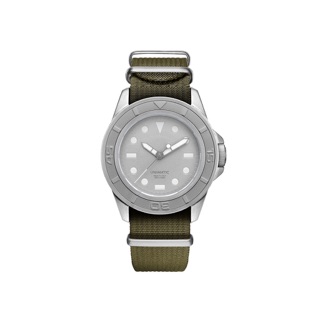
The UC1 as a numbered edition of 250, at $900 (€795), and the $140 over the Classic buys the edition number, the sandblasted insert and dial treatment, C1 lume in place of C3 and a second strap; the case and movement are the same watch. 40 mm (41.5 mm across the bezel), 49 mm lug-to-lug, 13.6 mm thick, 300 m, Seiko NH35A, 2.5 mm double-domed sapphire, a unidirectional 120-click bezel, brushed 316 steel, olive drab seatbelt NATO plus a black NATO. The U1-AEB is the same price. For the money the Halios Seaforth IV titanium at $765 runs a Sellita in titanium; the alternative inside the house is the UC1 at $760 with $140 left over.
Crystal2.8mm flat sapphire with lumed 24-hour scale, inner AR
BezelFixed monoblock
LumeSuper-LumiNova C1
Case material316 stainless steel, brushed
Price$920 (US price on the maker's site)
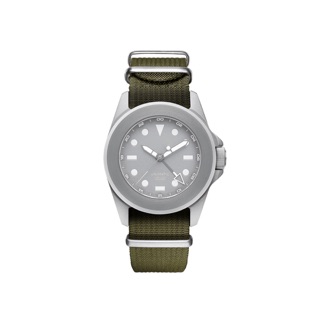
The fixed-bezel GMT at $920 (€795), an edition of 250, on the Seiko NH34A caller: the 24-hour hand is the one set independently, and Islander runs the same calibre from $369 and Nodus from $575. 40 mm, 49 mm lug-to-lug, 13.9 mm thick, 300 m, a 2.8 mm flat sapphire with a lumed 24-hour scale on the crystal itself, fixed monoblock bezel, Super-LumiNova C1, brushed 316 steel, olive drab seatbelt NATO plus a black NATO. The scale on the crystal is the part no one else here does. Lorier's Hyperion at $799 runs a Miyota 9075 true GMT for $121 less; the Unimatic's premium is the case, the rating and the edition.
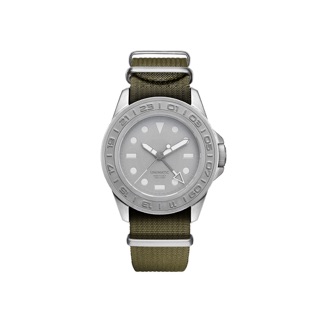
The most expensive Unimatic at $1,050 (€915), an edition of 250, and the one with a discrepancy on its own page: it lists the movement as a Seiko NH35A with GMT function, where the U4-GMT-AEG page lists an NH34A, and NH34 is Seiko's GMT calibre. 40 mm, 49 mm lug-to-lug, 13.6 mm thick, 300 m, 2.5 mm double-domed sapphire, a unidirectional 120-click bezel with a sandblasted aluminium 24-hour insert, Super-LumiNova C1, brushed 316 steel, seatbelt NATO plus a black NATO. Against the U4-GMT-AEG the $130 buys the rotating 24-hour bezel and the domed crystal, 0.3 mm thinner. The Nodus Contrail at $900 runs a Miyota 9075 true GMT with a rotating bezel for $150 less, when it is in stock.
Unimatic is for a buyer who wants 300 m on every model in a design-studio case and is content with nylon, since every model ships on a NATO or a two-piece nylon strap and none on a bracelet. On size, the 49 mm reviewer-measured lug-to-lug of the 40 mm cases runs 1 to 3 mm longer than the Lorier, Vaer and Traska equivalents at similar diameters, so the 38 mm UC2 at 47.6 mm is the one for a wrist under 7 inches. Look elsewhere if you want a sapphire or ceramic bezel insert, since Unimatic's are aluminium and Traska's Freediver is ceramic; if you want a true GMT with a jumping local hour, since the NH34 is a caller and Lorier's Hyperion is not; or if you want a Seiko NH35 at a Seiko-NH35 price, since Islander and Nodus run the same calibre from $349 and $650.
Where it sits against the field
The UC1 Classic at $760 sits in the same band as the Lorier Neptune ($699, 39 mm, 46 mm lug-to-lug, 200 m, Miyota 9039), the Vaer D5 ($729, 39 mm, 46 mm, 200 m, Miyota 9015), the Traska Freediver ($735, 40.5 mm, 48 mm, 200 m, 9039) and the Halios Seaforth IV titanium ($765, 40 mm, 46.5 mm, 200 m, Sellita SW200-2). The Unimatic gives 300 m where the others give 200 m and a Seiko NH35A where they give a Miyota or a Sellita, and on the review measurements it is the longest of the five. The UC2 and UC4 at $655 line up with the Nodus Sector Deep ($650, 38 mm, 47 mm, 500 m, NH35) and the Nodus Sector II Sport ($525, 38 mm, 47 mm, 100 m, NH38). The U4-GMT-AEG at $920 runs the same NH34 as the Islander JFK GMT ($449) and the Nodus Sector II GMT ($575), while the Lorier Hyperion ($799), Nodus Contrail ($900) and Traska Venturer ($950) run a Miyota 9075 true GMT for the same money or less. The U3-AEG at $840 is a meca-quartz chronograph in a band where Lorier's Gemini ($499) is hand-wound mechanical. Unimatic's premium, across the range, is the case and the Milan assembly, and the buyer should know that is what is being paid for.
Questions people ask
Where are Unimatic watches made?
Assembled and tested in-house near Milan, Italy, which the brand's about page says it brought in-house in 2021. Unimatic was founded in Milan in 2015 by two industrial designers and sells direct from its site and its Milan flagship, plus retail partners on its store locator. Every product page states a 24-month worldwide warranty.
Are Unimatic watches Swiss?
Mostly not. The Classic line and the U1-AEG run the Seiko NH35A automatic, the U4-GMT-AEG runs the Seiko NH34A GMT, the UT1 and UT4 run Seiko VH31A quartz, and the U3-AEG runs a Seiko VK64 meca-quartz. Two use Swiss movements: the UT1-GMT Toolwatch runs a Ronda 515.24D quartz GMT and the limited-run U5S runs a Sellita SW200-1. Assembly is in Italy for all of them.
Unimatic UC1 vs U1-AEG: what is the difference?
The edition number, the lume and the straps; the watch is otherwise the same: 40 mm, 49 mm lug-to-lug, 13.6 mm thick, Seiko NH35A, 300 m. The UC1 Classic is numbered in yearly batches, with C3 lume and a black anodized insert, on a black NATO at $760. The U1-AEG is an edition of 250 with C1 lume, a sandblasted insert and a seatbelt NATO plus a spare, at $900.