Steinhart sells its Ocean 39 divers direct from Germany, priced in euros with 19% VAT inside and no dollar figure anywhere, each on a Sellita in Elaboré grade at 300 m under a ceramic bezel. The two current nova models share one case to the hundredth of a millimetre, so the buyer decides on the movement alone, and then on whether a euro price and duties on arrival are acceptable.
Checked 20 September 2026 · list prices on the maker's site that day unless marked street
Steinhart sells direct from steinhartwatches.de and prices in euros with 19% German VAT included; there is no US storefront. The product pages carry the ex-VAT figure beside the list price, €621.85 for the Ocean One and €714.29 for the GMT, which is the number a buyer outside the EU starts from before duties. What the money buys is settled by the spec sheets, 316L steel, 20 mm lugs, a medium-domed sapphire with a double anti-reflective coating on the inside, ceramic bezel inserts, Super-LumiNova BGW9, and Sellita movements in Elaboré grade with hacking. The two nova models share one case, 39 mm, 46.78 mm lug to lug, 12.5 mm thick, 300 m, so the movement is the whole difference between them.
At €740 the Ocean One sits €110 above Baltic's Aquascaphe MK2 39.5 mm at €630, a Miyota 9039 at 200 m, and the Steinhart is the Swiss-movement one. Christopher Ward's Trident Pro 300 40 mm at £960 is the same Sellita, the same 300 m and the same ceramic, 1.2 mm thinner, and it comes with a dollar price Steinhart does not show. At €850 the GMT meets Baltic's Aquascaphe GMT MK-II at exactly the same figure, where Steinhart gives 300 m on a Sellita caller and Baltic 200 m on a Miyota true GMT.
Both nova models were in stock on 20 September 2026, and every price here is the euro figure the maker's site showed that day; nothing is converted, and because the site blocks scripted fetches the figures were read in a browser. The older Ocean 39 lines were still listed beside them, the Adventure Classic at €530, the Pink-Gold Ceramic at €550, the Metropole at €600, the GMT black-red at €710, the GMT.2 at €740 and the Titan Premium at €810; their spec sheets were not pulled, so they are named here and not tabled.
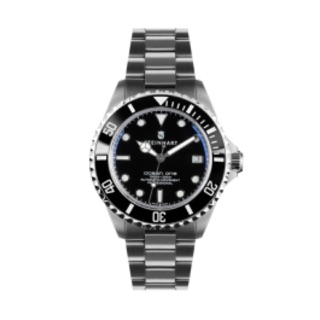
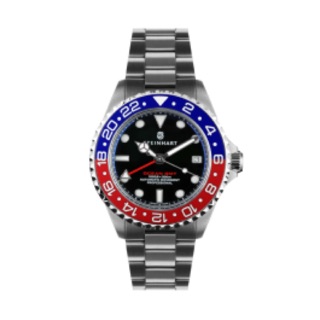
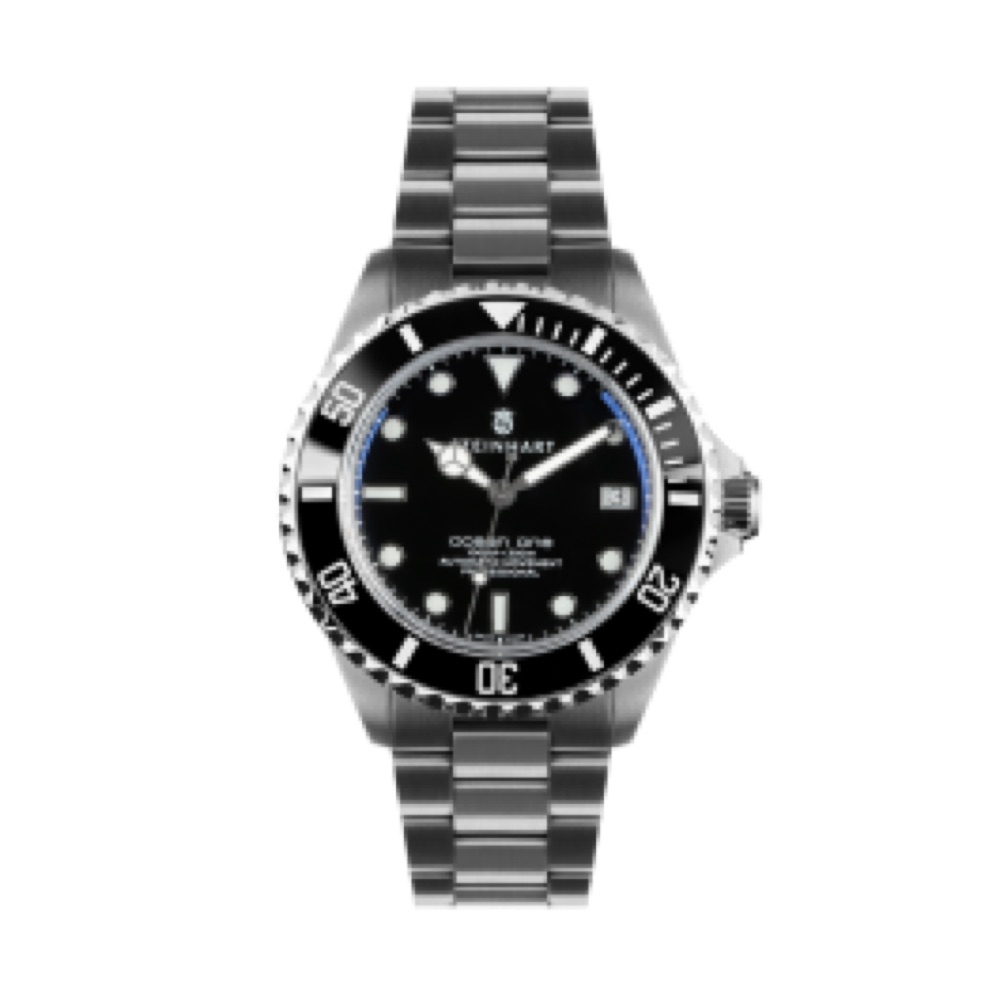
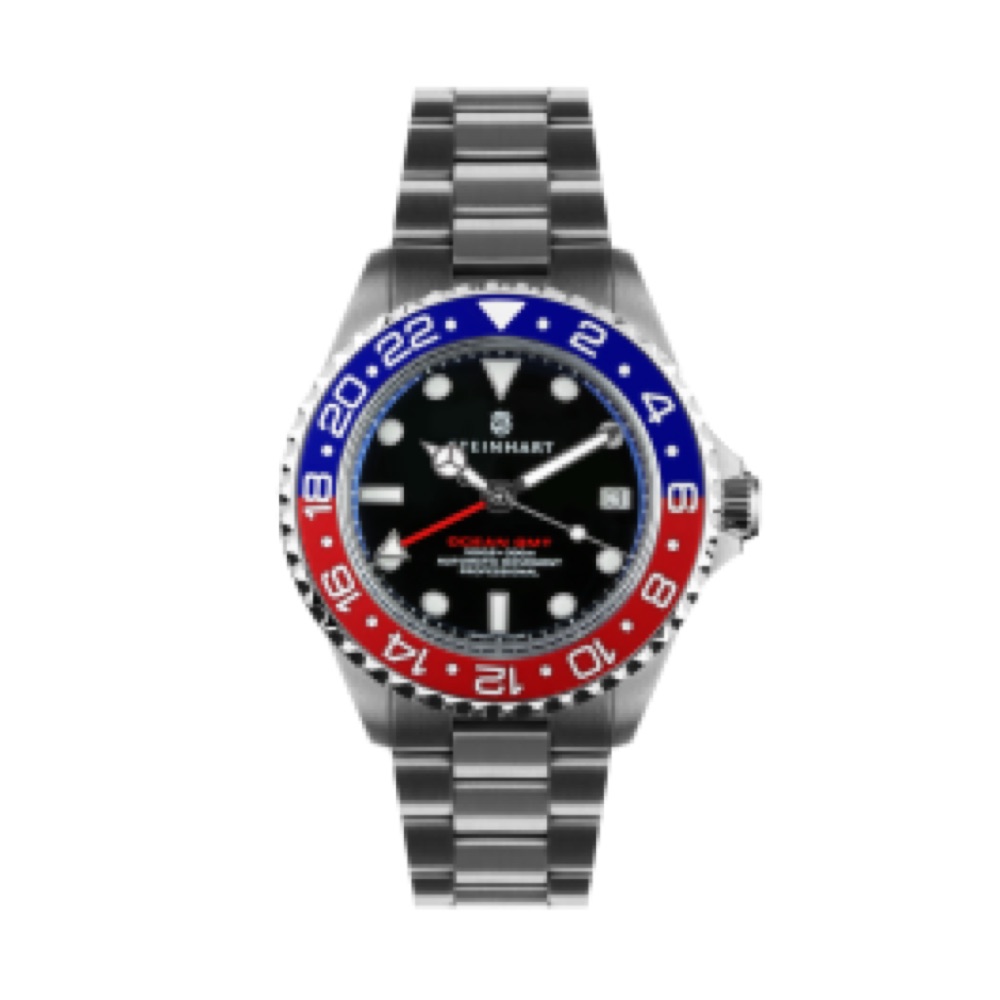
Read the table by movement, since the case does not move. The Ocean One 39 nova black runs the Sellita SW200-1 Elaboré under a unidirectional black ceramic bezel. The Ocean GMT 39 nova blue-red runs the SW330-2 Elaboré under a bidirectional 24-hour bezel with a blue-red ceramic insert, and the €110 between them is that movement and that bezel.
The Steinhart to buy, and the cheaper of the two by the €110 the GMT movement costs, at €740 including VAT and €621.85 before it, in stock when we looked. The argument is a Sellita SW200-1 in Elaboré grade and 300 m under a ceramic bezel at that figure. Christopher Ward's Trident Pro 300 40 mm is the same movement, depth and ceramic at £960, 1.2 mm thinner; Baltic's Aquascaphe MK2 is €110 less at 200 m on a Miyota 9039. Buy the Steinhart for the Sellita and the 300 m; the 12.5 mm height is the trade.
The GMT at €850 including VAT, €714.29 before it, and the €110 over the Ocean One buys the Sellita SW330-2 Elaboré and a bidirectional 24-hour bezel with a blue-red ceramic insert on an otherwise identical case. The SW330-2 is a caller GMT, so the 24-hour hand is the one you set. Baltic's Aquascaphe GMT MK-II is the same €850 on a Miyota 9075 true GMT at 200 m and 13.8 mm; Christopher Ward's Trident GMT 300 is the same Sellita at £1,215 and 11.7 mm. The Steinhart is the 300 m one; the Baltic's local hour jumps.
Steinhart is for the buyer who wants a Sellita in Elaboré grade, 300 m and a ceramic bezel at a euro figure, and who is content to pay in euros and settle duties on arrival. One case at 39 mm and 46.78 mm lug to lug suits a 6.5 to 7.25 inch wrist, and 12.5 mm is the height to measure against a cuff. Look elsewhere if you want a dollar price on the maker's site, since Christopher Ward shows one for the Trident at $1,320 and Tissot's Seastar 1000 40 mm lists at $875; if thickness matters, since the Lorier Neptune is 10.3 mm at 200 m for $699 and the Trident Pro 300 40 mm is 11.3 mm; or if you want a GMT whose local hour jumps, since the SW330-2 sets its 24-hour hand instead, and Baltic's Aquascaphe GMT MK-II at the same €850 and Lorier's Hyperion at $799 run the Miyota 9075.
Where it sits against the field
In euros the Ocean One at €740 sits €110 above the Baltic Aquascaphe MK2 39.5 mm (€630, Miyota 9039, 200 m, 47 mm lug to lug, 12.9 mm) and €10 above the Aquascaphe Titanium (€730, 300 m, 41 mm, 13.3 mm); the Steinhart is the Swiss-movement one and the thinnest of the three. Against the Swiss-franc Certina DS Action Diver 40.5 mm at CHF 835 (Powermatic 80, 300 m, 14.1 mm) it is 1.6 mm thinner. In sterling Christopher Ward's Trident Pro 300 40 mm at £960 is the closest match on the sheet, same SW200-1, same 300 m, same ceramic, 1.2 mm thinner. The GMT at €850 meets the Baltic GMT MK-II at exactly €850, where Steinhart offers 300 m on a Sellita caller and Baltic 200 m on a Miyota true GMT; the Trident GMT 300 at £1,215 is the same movement rated the same depth, 0.8 mm thinner.
Questions people ask
Where are Steinhart watches made?
Steinhart sells from Germany, at steinhartwatches.de, with 19% German VAT in the price. The product pages checked for this guide give Sellita movements from Switzerland in Elaboré grade, 316L cases and ceramic bezel inserts, and do not state where the case is made or the watch assembled; this page does not borrow a figure the maker has not published.
Does Steinhart sell in US dollars?
No. Steinhart has no US storefront and shows no dollar figure; the Ocean One 39 nova is €740 and the Ocean GMT 39 nova €850, each including 19% VAT, with €621.85 and €714.29 shown as the ex-VAT price a buyer outside the EU starts from. Duties and the card rate on the day set the rest.
Steinhart Ocean One 39 vs Ocean GMT 39: what is the difference?
The movement, the bezel and €110. Both are 39 mm, 46.78 mm lug to lug, 12.5 mm thick, 300 m, with 20 mm lugs and BGW9 lume. The Ocean One runs a Sellita SW200-1 Elaboré under a unidirectional black ceramic bezel at €740; the GMT runs an SW330-2 Elaboré under a bidirectional 24-hour blue-red ceramic bezel at €850.